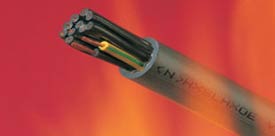
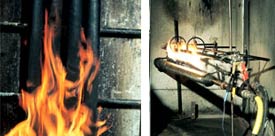
In
all locations, due to damages of
large amount of materials and more
of importance to protect human life
and technical equipment against damages
caused by fire and also for technical
enquiries of insurance, the installation
of halogen-free security cables is
required.
You will find on the next following pages the instructions for installation as
well as the test methods and laying indications of the halogen-free security
cables.
Halogens "formation of salt" are
the elements as fluorine, chlorine, bromine
and iodine.
Fluorine and chlorine are important for
cables and wires as atoms in the plastic
molecules, for example fluorine plastics or
PVC (polyvinyl chloride) are of significance;
and bromine as component of flame protection
additives.
Behavior under flame influence i.e.
the inflammability as well as the propagation
to fire
Subsequent damage by formation of corrosive
and toxic gases
Development of smoke density (darkening
of emergency exits hindered the fire
extinguishing works)
Cables produced
of not halogen-free materials
such as mainly the materials with chlorine
in the molecule chain: Polyvinyl chloride
(PVC), chloroprene rubber (CR), chlorinated
polyethylene (CM), chlorsulfonated polyethylene
(CSM) and fluor-hydrocarbons.
These material have better
behavior in case of fire.
These are hardly combustible or not flammable
and vastly self-extinguishing. Due to this
effect and in case of fire the released
molecules constituents chlorine and fluorine,
which hinder the admittance of oxygen to
the fire location and suffocate the flame.
The remarkable disadvantages
of these materials are existing in the
fact that the released chlorine and fluorine
atoms composite themselves with hydrogen
which is decomposed from plastic material
as well as with hydraulic acid or hydrofluoric
acid from the existing air.
These compositions are
extremely corrosive and also toxic. In
consequence the damage caused by corrosion
are often higher than the actual damage
caused by fire.
Halogen-free cables contain
no halogens, i.e. the insulation and jacket
materials of these cables are composed
with polymers on the basis of pure hydrocarbons.
By burning such kind of materials, produce
no corrosive or toxic gases but only water
vapor and carbon dioxide. Polymers like
polyethylene (PE) or polypropylene (PP)
are halogen-free. These materials are easy
flammable and not self-extinguishing.
Halogen-free cables for
security requirements must be hardly flammable
and self-extinguishing. This happens by
using the special polymer compounds, containing
the considerable percentage of flame protective
materials.
Such kind of protective
materials consist of, for example, an aluminum
hydroxide which on one side cools the fire
location by setting free crystal water
and on the other side the released water
vapor hinders the admittance of oxygen
and thereby this suffocates the flame.
By using additional supporting tapes and
filling yarns of glass web, micra and similar
materials, the functionality of for example
E 90 can be realized with the suitable
cable accessories.
The application
of halogen-free security cables and
wires are specified more and more
with increasing numbers of buildings
where people gather or everywhere,
where safety consciousness to protect
human life and valuable materials
take a special significance. For
example:
Hospitals, airports, multistory
buildings, stores and shops,
hotels, theaters, schools
Fire warning plants, alarm
systems, ventilation systems,
escalators, elevators, safety
lights, operation and intensive
stations, maintenance equipment
Underground railways and other
railway plants
Data processing installations
Power stations and industrial
plants with highly valuable machines
and materials or risky potentials
Mining works
Ship building and offshore
plants
Emergency power supply works
European -Security
cables and wires and the advantages
For designing a building
the criterions of the caloric load values are
very important. The caloric load values of
modern halogen-free cables are reduced by corresponding
additives.
The specific heating values of the non metallic
raw materials for cables are specified to
DIN 51900. The values of the caloric load
or heat of combustion for electrical cables
are given per running meter in the following
tables: Caloric
load values of halogen-free security cables
& wires (.pdf)
Combustible cable insulations or open building
materials of class B1 are regarded as harmless
so far as the resulted caloric load is distributed
as proportion ale as possible and is
valid ≥ 7
kWh/m2.
The total caloric load of the cables
are allowed up to 14 kWh per m2 of the field areas if only halogen-free cables with improved characteristics in the case of fire are used.
If you use PVC cables the total caloric
load is only up to 7 kWh per m2
The characteristics of security
cables are tested to DIN VDE specifications
(DIN VDE 0472 part 804, test methods A, B and
C)
Test Method A - test on single
cable (IEC 60332-2)
Test sample of 600 mm cable length shall
be in a position vertically hanging. A
propane gas burner (Ø 8 mm) shall
be at an angle of 45° to the axis and
the flame of approximately 100 mm below
the lower edge of the sample. Flame influence
max. 20 sec.
The test is passed if the sample has
not burned or the flame extinguished by
itself and the damage by fire doesn't reach
the remotest upper side of the sample.
Test Method B - test on single
cable
(IEC 60332-1, HD 405.1, EN 50265-2-1, DIN VDE 0482 part 265-2-1)
Test
sample of 600 mm cable length shall be
in a position vertically hanging. A propane
gas burner (Ø 8 mm) shall
be at an angle of 45° to the axis and
the flame of approximately 100 mm below
the lower edge of the sample. Flame influence,
depending on cable weight, 1 to 2 minutes.
The test is passed if the sample has
not burned or the flame extinguished by
itself and the damage by fire doesn't reach
the remotest upper side of the sample.
Test Method C - test on bunched
cables
(similar to IEC 60332-3, HD 405.3, EN 50226-2, DIN VDE 0482 part 2)
Test samples of 360 cm cable length are
laying parallel side-by-side attached to
a test ladder, which is hanging vertically
with a distance of 150 mm to the furnace.
The sample should be flamed with a flame
length of 60 cm on the test sample at approximately
800 °C by a burner width of approximately
250 mm. The test duration should be 20
minutes.
The test is passed if the sample has
not burned or the flame extinguished by
itself and the damage by fire doesn't reach
the remotest upper side of the sample.
According to DIN VDE 0472
part 813, IEC 60754-2 and HD 602, DIN VDE 0482
part 267, EN 50267-2-2. For the performance
of the test procedure the insulation and jacket
materials are to be put in the moveable
furnace, preheated to 750 to 800°C.
The burning gas is conducted through two
gas-washing bottles.
The test shall be regarded as passed
when the measured pH value is ≥
100 µS.cm-1
During this test all the not desired
components of the materials are precipitated
such as all halogens, sulphur and nitrogen
Continuance
of insulation effect under direct
fire conditions
Test sample of 1200 mm cable length is fixed
in a horizontal position, 75 mm over the
gas burner. The rated voltage of 3 A fuse
is fixed between the conductor groups. The
burner flame is to regulate so that the temperature
on the cable is 800°C (± 50°C)
The measuring can be effective until the
fuse is blown.
Test voltage 400 V for power cables
and wires
Test voltage 110 V for telecommunication cables
The test shall be regarded as passed
when no 3 a fuse has blown during the test
period between 20 to 180 minutes
According to DIN VDE 0472
part 815, IEC 60754-1, Din VDE 0482 part 267
an dEn 50267-2-1
The corrosion test of gases caused by fire
is carried out to the test materials, not
of complete cable samples. The proof of halogen
is effected by chemical analysis.
Materials with content of:
≤
0.2 % chlorine and
≤0.1 % fluorine
are regarded as halogen-free.
According to DIN VDE 0472
part 816, IEC 61034-1 and IEC 61034-2, DIN
EN 61304-1+2, HD 606 and BS 7622 part 1 and
2
The test of smoke density is effected to a
single cable, laid in a horizontal position
within a room of 3 meter cube. The photo metrically
measured absorption of light is a measuring
unit (in %) of light transmittance for the
smoke density.
The test is regarded as passed when the
light absorption appears within 40 minutes
and the following values shall be obtained
for light transmission:
According to DIN 4102
part 12 (system test)
DIN 4102 part 12 describes the requirements
and measurements necessary in achieving
circuit integrity of a complete electric
cable system in case of fire.
Cable systems Regarded as cable systems are power
cables, insulated power cables and wires,
telecommunication installation cables for
telephone and data transmission and rail-distributors
including their corresponding connecting
devices such as the necessary ducts and conduits,
coatings and coverings, connecting elements,
supporting devices, cable trays and clamps.
Functionality
According to DIN VDE 4102 part 12
The functionality is given when during the
test under fire no interruption of current
flow occur in the tested electrical cable
system.
According to this standard, the security
cables are always to be tested together with
the corresponding supporting devices, clamps,
holder and mounting accessories.
Note: The above defined functionality has
no relationship with the continuance of insulation
effect under fire conditions according to
DIN VDE 0472 part 814.
During this test under fire
a complete cable installation will be tested
in a large combustion chamber, i.e. cables
and wires including clamps, supporting devices,
holders, dowels etc.
Test voltage for power cables:
380 V
Test voltage for telecommunication cables:
110 V
Current load:
3 A
The combustion chamber is to be heated up
according to ETK (standard temperature
curve). The test period is distinguished
in 3 classes:
E 30 for the functionality ≥ 30 minutes
E 60 for the functionality ≥ 60 minutes
E 90 for the functionality ≥ 90 minutes
Raise of temperature in combustion chamber:
For E 30 approximately 820°C
For E 60 approximately 870°C
For E 90 approximately 980°C
After passing the functionality test,
this will be certified with the class identification
as E 30, E 60, E 90.
Note: At the moment the class E 60, which
is specified in DIN VDE standards, is not
applied for economical and technical reasons.
is the Exclusive Importer of HUMMEL products. We offer over 6,000 different Types and Sizes of RoHS Compliant Liquid Tight Strain Relief Fittings, Cord Grips, Cable Glands, Circular Connectors, Conduit System, Industrial Enclosures and Other Related Cable Management Products which are rated the best in the industry.
7374 S. Eagle Street
Centennial, CO 80112-4221 USA
Toll Free: 800-456-9012 / 303-699-1135 FAX: 303-680-5344






 All-weather, Rubber & Welding
 Halogen-free Security Cables
 Introduction