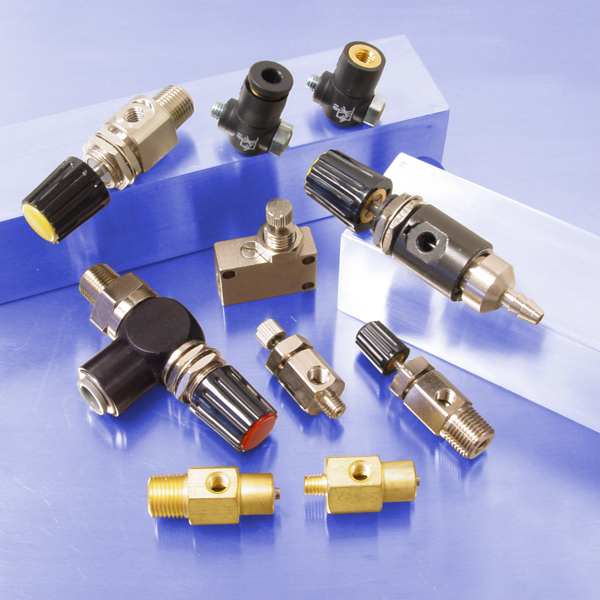
Flow Control Valves
Flow Control Valves are used to reduce the rate of flow in a section of a pneumatic circuit, resulting in a slower actuator speed. Unlike a Needle Valve, Flow Control Valves control flow in only one direction, allowing free flow in the opposite direction. A finely threaded stem allows gradual adjustment of the amount of controlled flow passing through the valve. Flow enters port 1, travels through an orifice sized by the tapered stem and out port 2. The Flow Control features a by-pass check which then allows rapid free flow from port 2 through port 1.
There are two types of Flow Controls and their selection & placement within a pneumatic circuit greatly affects the function of an actuator.
- A Meter-In Flow Control (also referred to as a Reverse Flow Control) restricts the flow to an actuator.
- The most commonly used Flow Control is a Meter-Out valve which controls the exhaust flow from an actuator.
Flow rate requirements are extremely important when selecting a Flow Control valve for your application. The speed of the related actuator is dependent upon how quickly the actuator can be filled with air at the input and exhausted at the output.
|








 Pneumatics
 Brass Pipe Fittings